


BY PAUL T HORGAN
It is reasonable to state that the reputation of the Royal Air Force’s Bomber Command has been trashed ever since the end of the Second World War. This explains why it took until 2012 for a proper memorial to its airmen to be erected in London. One of the accusations levelled at the Main Force (the element of Bomber Command equipped with four-engined heavy bombers) is that the night raids did not alter the course of the war in proportion to the investment in men and materials. This is not reasonable. None of the accusers, mainly from the Left, have ever put forward a valid counterfactual as to how British air power could be better re-purposed. The charge is also false. Of all the fighting arms, the Royal Air Force was first to open the Second Front demanded by the USSR and the British Left of the day. By deploying hundreds of heavy bombers nightly over the Third Reich, the Germans were required to deploy fleets of night fighters that could have been used against Soviet fighter planes, and thousands of pieces of anti-aircraft (AA) artillery. Every 88mm AA-gun on German soil was one fewer than Stalin’s T-34s had to face in Russia as the flak guns were also notoriously effective anti-tank weapons. Every concrete air shelter took away from the materials needed to build concrete bunkers on the Eastern Front or to fortify the European coast against amphibious invasion. An AA-gun situated in Munich was useless against a raid mounted on Cologne, and AA guns had to be sited and manned everywhere in Germany just in case.
There is also the charge that the RAF needlessly killed thousands of civilians during the raids. This is an issue of targeting technology. In 1939 Bomber Command’s strategy was to deploy unescorted formations of bombers in daylight raids to perform precision strikes on German military installations. At the outbreak of war, Britain and France had pledged to President Roosevelt not to attack civilian targets. It was believed that the for-the-time heavy armament of multiple machine guns in power turrets would be able to protect the bombers from harm.
This notion crashed and burned with 50% of the force that tried to attack the German Navy and was slaughtered over Heligoland Bight. Bomber Command had to learn night bombing from scratch.
It took slightly under three years to start to get it right, including moving to a strategy of “dehousing” the industrial workforce of Nazi Germany using area bombing, as bombers simply could not successfully hit a target any smaller than a town. During the war the Main Force only attempted two precision night strikes against strategic targets, both in 1943. The first was the Dams Raid, which cost over 40% of the attacking force, but had a spectacular outcome. The second was against the V2 rocket testing site at Peenemünde that delayed the unleashing of the missiles on the British mainland until after D-Day and has been estimated to have saved about 2,500 civilian lives that would have been lost had the attacks started earlier. Again, none of the critics of Bomber Command has ever proposed an alternative strategy to dehousing as a way of defeating the Nazis. Bomber Command’s chief Arthur Harris promised Allied victory through air power alone without an Allied boot setting foot on Europe but did not deliver. This does not mean that the raids weren’t consequential. It is just that it was almost impossible for the RAF to accurately measure the consequences of a given raid and to adjust strategy.
In 1943, the RAF’s devastation of Hamburg in a firestorm comparable to a tactical nuclear strike precipitated, in addition to disruption to military production, a domestic political crisis in Nazi Germany, creating the possibility of a popular uprising to depose the dictatorship. Had Bomber Command managed to burn out a few other cities in the same manner in quick succession (Berlin was too large to similarly devastate), then the Nazi leadership could have fallen despite the best efforts of the Gestapo. Earlier in the year, the raids on the industrial centres of the Ruhr had delayed the manufacture of the Panther Tank, an armoured fighting vehicle designed to see off the Soviet T-34 that had been outclassing German Panzers since the end of 1941. This delay caused the offensive against the Kursk pocket to be put back, allowing the Soviets to build up their layers of defence.
Bomber Command’s Main Force was also deployed to great effect in degrading rail and other infrastructure in Northern France, which prevented German forces from moving rapidly into the combat area during the Battle of Normandy. By 1945, the expertise accumulated since 1942 allowed crippling raids against transportation and oil plants. The night raids disrupted military production and retarded Germany’s economic growth. Those that decry Bomber Command for the destruction of Dresden are actually repeating propaganda originated by Josef Goebbels. The critics are the useful idiots of Nazism. Unlike other ‘Fortress Cities’ Dresden fell without a fight to Soviet armies.
Dresden was also a major military manufacturing centre right up to its destruction. Its remaining Jews were set to be deported to death camps the day after the firestorm. Instead, they survived the war.
All of the raids were part of an industrial process of progressively degrading Germany’s ability to fight. But in amongst these are a couple of raids that had a permanent effect on Germany’s ability to wage war, but have not been marked, certainly not in British popular culture, to the same extent as the raids on the Dams, Hamburg, or Dresden. I refer to the two raids in early 1943 on Wuppertal.


Wuppertal is a linear city, its buildings closely lining the River Wupper, which runs through a valley lined with steep hills which restricted its growth in the 20th century compared to, say, Cologne. It is located in the West of Germany in lands given to the Kingdom of Prussia by the Congress of Vienna in 1815. The city was also the wartime manufacturing centre for Tego-Film, a dry, heat-cured adhesive film used to bond layers of plywood. As such Tego-film was a strategic material. Wait, glue? A strategic material?
If a relatively knowledgeable person was asked to list the greatest RAF aeroplanes of World War II, the top four would probably be the Spitfire, Hurricane, Lancaster, and Mosquito. Of the four the multi-role Mosquito was unique in that it was constructed primarily of wood rather than aluminium. While the Hurricane did use a doped fabric covering metal struts for its rear fuselage, it was the last iteration of a line of Hawker fighters that had been in service since the early 1930s. The Mosquito, when it was developed, was state-of-the-art. Its performance edge was due to the use of wood laminates (arguably literally a form of naturally-occurring carbon-fibre) making the fuselage very light for its strength compared to the stressed aluminium used on its contemporaries. Additionally, wood was an abundant material that was far easier to source than aluminium, which required extensive industrial plant to smelt from a mineral called bauxite that had to be imported through U-Boat infested waters. The resulting fuselage, when mated with a pair of Rolls-Royce Merlins, created a very fast bomber that was able to use speed rather than defensive fire to evade German defences. Only a single Mosquito was shot down during its first 600 sorties over enemy territory.


In January 1943, on the tenth anniversary of the Nazi seizure of power, the live broadcast of the celebrations had to be curtailed because of a Mosquito raid in broad daylight over Berlin. Hermann Goering had to postpone his speech for an hour as a trio of the bombers targeted the headquarters of German radio. When Josef Goebbels spoke at a rally in a sports stadium, he had to do so over the sound of air raid warnings and bombs exploding, as a second trio of Mosquitos made their presence felt. No German fighter got close enough to bring down any of the British planes, but the fully-alerted defences managed to hit one of the Mosquitos in the second raid, killing the two-man crew. Goering, who had boasted in 1940 that no British bomber would ever reach Berlin, raged:
“In 1940 I could at least fly as far as Glasgow in most of my aircraft, but not now! It makes me furious when I see the Mosquito. I turn green and yellow with envy. The British, who can afford aluminium better than we can, knock together a beautiful wooden aircraft that every piano factory over there is building, and they give it a speed which they have now increased yet again. What do you make of that? There is nothing the British do not have. They have the geniuses and we have the nincompoops.”
In addition to being a superb high-speed bomber (Mosquito raids on Berlin duped Germany’s night fighters giving two of the three waves of Main Force bombers a clear run at Peenemünde), the Mosquito was also deployed as a highly-effective night fighter, as well as a stealth intruder employed to shoot down German night fighters and bombers as they were landing at their bases. Goering’s rage was well-placed.
Rather like the Panther was Germany’s answer to the T-34, so the Luftwaffe charged the German aircraft industry to come up with their own all-wood high-speed warplane. The design contest was won by the Focke-Wulf company. The aeroplane, the Ta-154 (prefixed in honour of its designer, Kurt Tank, rather than the name of the firm as was the previous practice), was called ‘Moskito’ in homage to its inspiration. And this is where the Wuppertal raids come in. The skin of wooden airframe required a strong adhesive. It could not be held together by nails. The secret of the Mosquito’s success came in the glue used in bonding layers of plywood. Germany also had a market leader in adhesive manufacture for airframes, and that was Tego-Film.
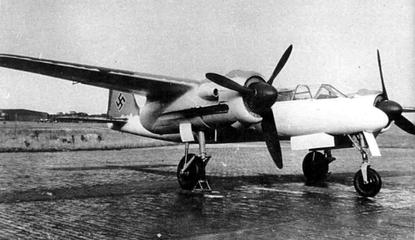
And here is where there is the mystery. The 1943 raids on Wuppertal destroyed the only plant in Germany that manufactured Tego-Film, and the production never resumed for the rest of the war. Bomber Command successfully destroyed or damaged numerous factories in the Third Reich, but the outcome was usually a reduction in output that was only more-or-less temporary. Machine tools could be repaired or replaced. If only the buildings were damaged, manufacturing premises could be relocated.
Much is made of the fact that Bomber Command never actually halted military production in Nazi Germany, and at best only reduced its growth. However, in the case of Tego-Film, Bomber Command killed production stone-dead. How? Were the production facilities somehow irreplaceable? Had the formula for the material’s manufacture been lost, as it was never patented and the intellectual property was kept a closely-guarded secret (as apparently is Coca-Cola and Heinz Tomato Ketchup) that disappeared in the ruins of the factory? That one day a factory could churn out an item and then one or two raids stopped it for the rest of the war appears without precedent. There seems no explanation for how this came about. The Luftwaffe still wanted the Ta-154, but the substitute glue was found to be acidic and would dissolve the wood. The planes ran the risk of literally falling apart at speed. Any adhesive had to be able to withstand the forces of a headwind of over 400mph, and the much-famed German chemical industry never developed a proper replacement. A shortage of glue caused the Ta-154 to be cancelled.
By Autumn 1944, the position of Nazi Germany was dire as Allied planes established air superiority over the Third Reich. A call went out for a ‘People’s Fighter’ to be powered by a jet engine and armed with two 20- or 30-mm cannons, but largely built from non-strategic materials, such as wood. It was meant to be flown by members of the Hitler Youth with minimal training. The Heinkel He-162, manufactured with second-rate glue, flew three months after the specification was created. On a high-speed test flight in front of dignitaries, the trailing edge of the wooden wing peeled off, crashing the plane and killing the pilot.
.jpg,)
The deployment of wooden aeroplanes would not have saved Germany from 1943 onwards. Knocking out Tego-Film production just reduced Germany’s options in what was, by the late Summer of that year, an increasingly terrible situation. Germany could no longer win the war, having in quick succession lost the Battle of the Atlantic, its position in North Africa, the Battle of Kursk, and its major European ally Italy. By October 1944, the war was lost for Germany, but had to be fought to bloody conclusion as the Allies determined, rightly, that only unconditional surrender of a country run by genocidal fanatics would suffice. The Luftwaffe, set up to fight short wars against weaker neighbours, had not prevented the devastation of numerous German cities and towns over the long term. It needed new pilots more than it needed better types of planes, wooden or otherwise, and this increasing human shortfall and a catastrophic fuel shortage (oxen were used to tow German fighters to runways in the end) would lead to its downfall months before Germany surrendered.
But still the mystery endures. How could a couple of raids wipe out an increasingly vital component of the declining German aviation industry? What was it about the factory in Wuppertal that made it irreplaceable? Was it that a well-held trade secret was lost in the rubble? Despite all the revelations made after the fighting ceased in 1945, this admittedly rather minor mystery remains.
Paul T Horgan worked in the IT Sector. He lives in Berkshire.