


BY ANDREW TETTENBORN
Nemesis overtook the Archbishop of Canterbury this week. He resigned on Tuesday, following overwhelming calls for him to go following the publication of the Makin Review, a report commissioned by the church over his conduct of the John Smyth abuse affair. But there is an irony here. There is a strong argument that this wasn’t really the slam-dunk resignation matter everyone made it out to be. By contrast, there were many other, perhaps more important, things seriously wrong with Justin Welby’s tenure of the Church of England’s hot seat, which means that in some circles his going will not be much regretted.
For those who don’t know the background, the subject of the Smyth affair was a Jekyll and Hyde character on the fringes of the church in the 1970s and 1980s. A successful barrister, evangelical crusader and lay reader in his Winchester church, he was also a pervert with a taste for extreme beatings of young men (often carried out with both parties naked).
In the early 1970s Smyth became involved with the Iwerne Camps, a muscular Christian organisation that arranged camping holidays for young men from the better schools, including many who later rose in the church (not to mention a youthful Justin Welby), where he indulged his desires with a vengeance. Few complained, but enough information got out to give him an unsavoury reputation. In 1982 an internal report detailed some of these events; in 1984, his position by then untenable, Smyth was quietly packed off to Zimbabwe and later South Africa, where by all accounts he continued his activities. He died in 2018.
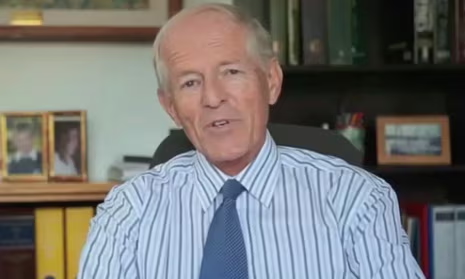
John Smyth
Welby’s involvement was, effectively, that he attended Iwerne Camps, knew Smyth, was warned at various times in the 1980s of suspicions about his activities, and later sent money to his supposed ministry in Zimbabwe. Most of this took place before Welby was ordained in 1992. However the essence of the complaint about him was that about the time of his elevation to Canterbury in 2013, he was told of the allegations against Smyth in some detail, and later liaised with safeguarding authorities in the church, but did not act on what he had heard by passing the information to the police, either here or in South Africa. By the time the UK police did get involved Smyth was very old, and died the next year. As a result Smyth never stood trial and his abuse abroad continued.
This may look like a smoking gun, especially from the point of view of the victims (for whom one has every sympathy, and whose interests the Makin report openly prioritised). But how damning is it as regards Welby? A new archbishop of Canterbury has a great deal on his plate. Is it really his solemn duty to cast his mind back to events taking place before he was even ordained and go on to prioritise the chasing down of a 72-year-old flagellation fetishist who has not lived in Britain for 30 years and is now ensconced on the other side of the world? It’s not even as if Smyth in carrying out his sadistic practices against young men was acting on behalf of the church in promoting his perverted brand of Christianity. He had never been in holy orders or noticeably part of the hierarchy: for some reason the Makin review saw it as significant that he was a lay reader, but in practice this status means little or nothing.
True, it might be said that earlier action from Welby might have prevented further abuse in Africa. But we need a sense of proportion here too. Is it an Archbishop’s function to use his time to prevent junior churchmen abroad misbehaving merely because allegations have been brought to his attention and he knew the man many years ago? So much so that it is a resignation matter if he doesn’t? It seems doubtful.
The irony is that, for any sound churchman, there are any number of worse ways in which during the Welby era the Church of England and the country it represents has been let down. Most dwarf the matter of the omission to take more steps to bring John Smyth to book. Here are a few. During Covid, Welby spectacularly failed to fight the Church’s corner or make the argument for keeping public worship available, simply telling Anglicans to do as they were told by the secular authorities. At other times he effectively refused to accept the church’s teaching on marriage and sexuality (“where we’ve come to is to say that all sexual activity should be within a committed relationship, and whether it’s straight or gay”). Spectacularly commingling what was owed to Caesar and to God, he imported into his Christian doctrine secular nostrums such as Europhilia and curbs on democracy (“Some analysis … is called for before the Churches can effectively contribute to a wider vision to counteract neo-nationalisms and populist politics”), net zero fanaticism as a means of transforming “unjust structures,” and iconoclasm in the name of racial identity politics (“the statue needs to be put in context. Some will have to come down”).
Unfortunately nuances like this are now lost. The Makin review rather simplistically sees the church’s safeguarding duty as first and foremost; the whole tone of it is that the church’s other functions are to some extent peripheral and less important. This is perhaps unsurprising; the whole thing is written like some rather dreary sociological paper, and the writers are headed by an ex-director of social services and safeguarding guru.
Depressing, however, the existing leadership of the church pretty clearly now thinks in the same way. Just as politicians fetishise about safety over other values such as freedom, in religion the established view is that everything must give way to safeguarding. After all, the hierarchy commissioned the report and presumably had a pretty good idea what it was going to get.
We don’t yet know who the next Archbishop will be. It could, and should, be someone who views the Church of England as not so much a kind of religious social service as first and foremost an organisation looking to the spiritual welfare of Englishmen, taking safeguarding in its stride where possible. But few on the bench of bishops hold such contrary views; and even if one does, they probably haven’t a chance of getting the key to Lambeth Palace. Don’t hold your breath.
Andrew Tettenborn is a writer and academic. Readers can follow Andrew on Twitter here, in The Spectator here, in The Critic here, in Spiked Online here, and in the Catholic Herald here.